商业与经济
Why pharma firms are going to Earth’s orbit in search of new cancer drugs
来源: Business | The Guardian · 发布于
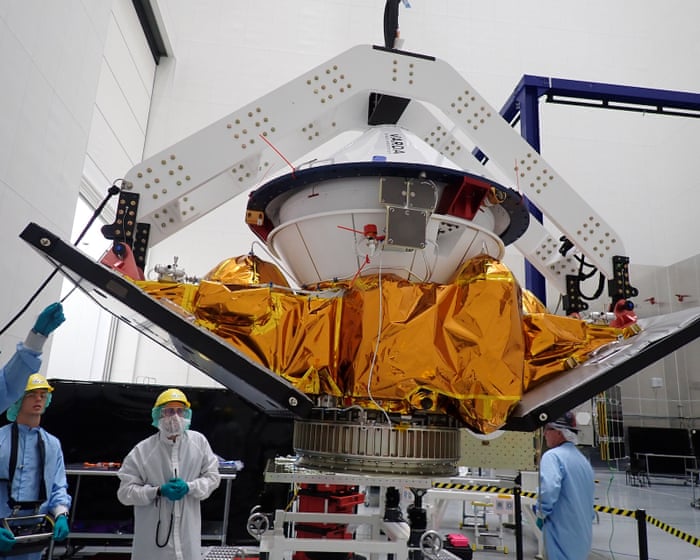
A space capsule 300 miles above us is growing the tiny crystals of a potential cancer drug in microgravity Roughly 300 miles above our heads, three washing machine-sized capsules are orbiting the Earth. Inside one of them, tiny crystals of a potential cancer drug are being grown
A space capsule 300 miles above us is growing the tiny crystals of a potential cancer drug in microgravity Roughly 300 miles above our heads, three washing machine-sized capsules are orbiting the Earth. Inside one of them, tiny crystals of a potential cancer drug are being grown in the weightlessness of space. The others are testing heat protection materials and navigation systems for when the capsules plunge back through Earth’s atmosphere at hypersonic speeds.
Together, they represent a small but significant step towards what some hope will become a lucrative new industry: manufacturing drugs and other materials in space. The spacecraft belong to California-based Varda Space Industries. On 1 October, it launched two onboard the same rocket, followed by the third on 20 October.
With a record three spacecraft now simultaneously in orbit for the first time, the company is edging closer to its ambition of operating a fleet of orbiting pharmaceutical factories. Continue reading...
相关报道

"At Home in Space" opens, caps Air and Space Museum renovation
After seven years of work and nearly $1 billion, the Smithsonian has completed the renovation of the National Air and Space Museum's flagship building in Washington, DC. On October 30, the museum debuted its last-to-open spaceflight exhibition , returning "home" with a gallery de
Ars Technica - All content ·
Meteors don't just burn up. What really happens is far more violent
Scientists have uncovered seven surprising stages that space rocks go through as they hurtle toward Earth, revealing that melting and violent fragmentation, rather than simple evaporation, determine their fate. The discovery could help explain why meteorites scatter across the gr
All Top News -- ScienceDaily ·
Scientists discover a hidden oxygen reservoir deep inside Earth
Scientists have discovered that magma deep inside Earth can store surprising amounts of extra oxygen, potentially revealing a hidden contributor to our planet's oxygen-rich atmosphere. The findings suggest that ancient volcanic eruptions may have helped transform Earth's atmosphe
All Top News -- ScienceDaily ·

'I live with a ghost' - inside the haunted homes attracting bargain hunters
Properties where someone has died in tragic circumstances can have big reductions in price.
feeds.bbci.co.uk ·
Orbital Matter 3D-printed the first rigid beam in the vacuum of space
An in-space construction first could be an enabler for the space data centers of the future.
TechCrunch ·