科技与人工智能
Watching as a giant star swallowed its neighbor and exploded
来源: Ars Technica · 发布于
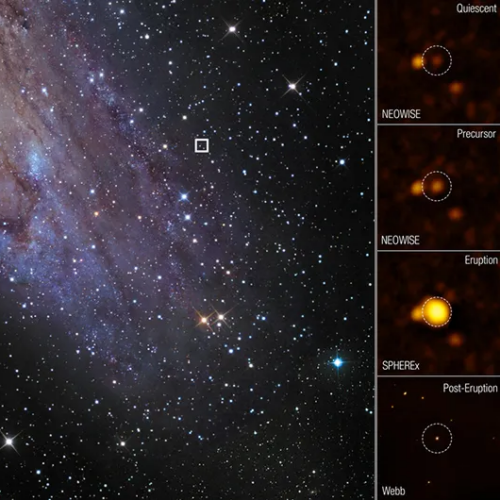
In the Andromeda Galaxy, a giant star about seven times as massive as the Sun spent nearly a decade slowly swallowing its much smaller companion. The process, known as common envelope evolution, was proposed in the 1970s to explain how some of the tightest pairs of stars in the U
In the Andromeda Galaxy, a giant star about seven times as massive as the Sun spent nearly a decade slowly swallowing its much smaller companion. The process, known as common envelope evolution, was proposed in the 1970s to explain how some of the tightest pairs of stars in the Universe form, but no one had ever caught it in the act. In a new Nature study, astronomers led by Viraj Karambelkar, an astrophysicist at Columbia University, finally witnessed the entire spectacle from the decades before it began to the eruption that ended it in late 2025.
“It lasts for a few years, maybe a few decades,” Karambelkar said. “Stars evolve on time scales of millions of years. So, it's really like a blip on the entire cosmic time scale.” Shared envelopes Some pairs of stars orbit so close to each other that they could not have formed at that distance, so their orbits must have shrunk.
Common envelope evolution is the leading explanation for that shrinkage. When one star in a binary grows old, it expands into a giant, and its outer layers can engulf its companion. The two then share a single, loosely bound envelope of gas.
As the engulfed star drags through it, it loses orbital energy to friction and spirals inward. Depending on how much of the envelope gets lost, the pair either ends up in a much tighter orbit or merges. Read full article Comments
相关报道
Rockies All-Star Goodman expected back for spring after shoulder surgery
Rockies All-Star catcher Hunter Goodman is expected to be ready for the spring after undergoing offseason surgery to clean up his left throwing shoulder.
espn.com ·
Astronomers discover a dead star spinning every 8 minutes and sending mysterious radio pulses
Scientists have discovered a strange stellar pair more than 5,000 light-years away, where a dead star spinning every eight minutes produces mysterious radio pulses while orbiting a Sun-like star. The breakthrough also revealed massive magnetic storms on the companion star, offeri
All Top News -- ScienceDaily ·

The GTA 6 star system says a lot more than just your Wanted level
Just committing a robbery doesn't necessarily mean your Wanted level will rise.
Engadget - Technology News & Expert Reviews ·

Sterling K. Brown in Talks to Star in New ‘Longlegs’ Movie with Nicolas Cage
Sterling K. Brown is in negotiations to star in Paramount’s new “Longlegs” movie opposite Nicolas Cage, Variety has confirmed. Plot details and a character description for Brown remain under wraps. Original director Osgood Perkins returns to helm the sequel. He also penned the sc
Variety ·

Researchers trace shifting pulsation modes in δ Scuti star KIC 4737720
Stars in the night sky may look calm and unchanging, but some are in fact constantly "vibrating." Just as a musical instrument can sound several notes at once, a star can pulse in several modes simultaneously. By measuring minute changes in a star's brightness, astronomers can re
Phys.org - latest science and technology news stories ·