科技与人工智能
These ‘Ghostly’ Galaxies Have Lost Their Dark Matter
来源: WIRED · 发布于

The galaxies’ dark matter was ejected during a collision, but ironically, its absence is some of the best evidence of the elusive substance yet.
The galaxies’ dark matter was ejected during a collision, but ironically, its absence is some of the best evidence of the elusive substance yet.
相关报道
Dark energy may have flipped from negative to positive 9.5 billion years ago
A mysterious force driving the expansion of the Universe may have undergone a dramatic reversal billions of years ago. Scientists exploring an overlooked branch of an alternative gravity theory discovered that dark energy could have switched from negative to positive roughly 9.5
All Top News -- ScienceDaily ·
‘The Body’ Was Meant to Be Dark. Geena Meszaros Also Makes It Hilarious
The star of Netflix's newest teen horror-comedy talks about letting her freak flag fly as an outcast suddenly thrust into the world of the popular girls
Rolling Stone ·
A radical theory says the universe is twice as old as we thought
A provocative new cosmological model suggests the Universe could be 26.7 billion years old and might not need dark matter or dark energy to explain its behavior. University of Ottawa researchers tested the theory against several major astronomical observations, finding that it co
All Top News -- ScienceDaily ·
Einstein's equations may explain the universe without dark energy
Mathematicians have uncovered what they argue is a fundamental flaw in the standard model of the universe, potentially challenging the need for dark energy. Their calculations suggest that the mathematical framework used to describe cosmic expansion is inherently unstable and tha
All Top News -- ScienceDaily ·
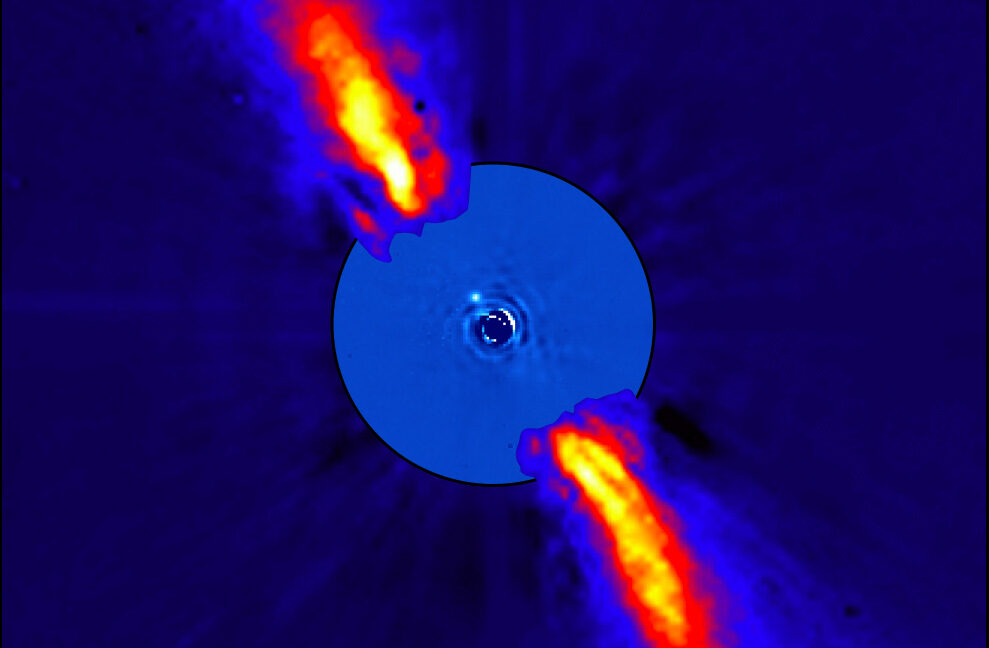
James Webb telescope finds ice older than the star it orbits
Beta Pictoris is a young star, roughly 20 million years old, and located about 64 light-years away from Earth. It is surrounded by a vast disk of dust and rubble where planets are still forming—astronomers have already found three. In a new Science study, a team led by Sarah Bett
Ars Technica ·