科学与环境
Dirty ice around young star Beta Pictoris suggests frequent collisions and sheds light on the system's formation
来源: Phys.org - latest science and technology news stories · 发布于

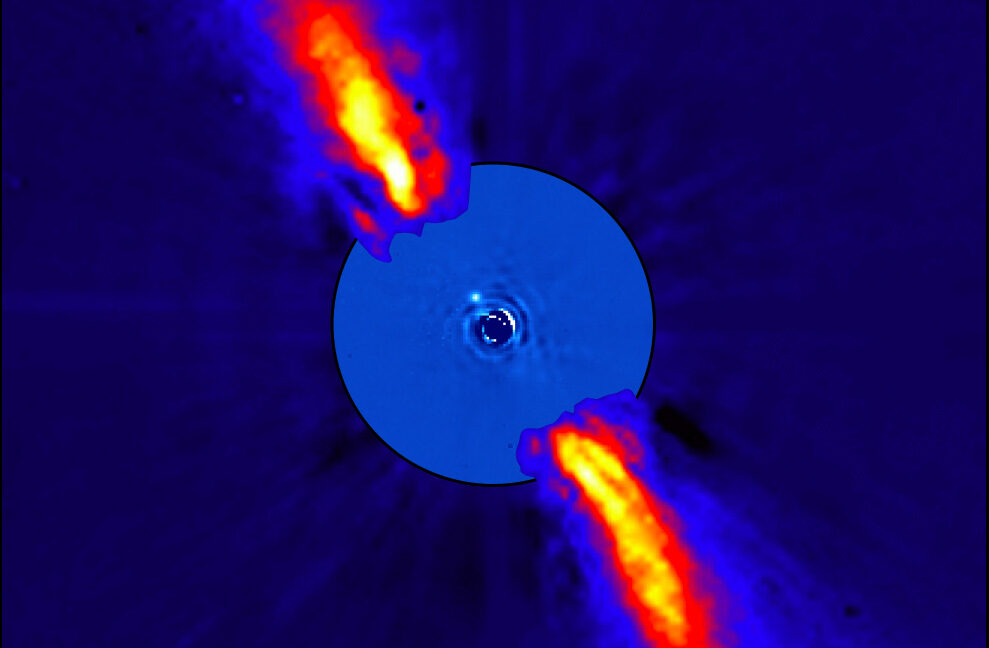
In a recent study of infrared light collected by the James Webb Space Telescope (JWST), a group of astronomers detected ice for the first time around the young star Beta Pictoris. Researchers had expected ice around Beta Pictoris, but previous searches had not directly detected i
In a recent study of infrared light collected by the James Webb Space Telescope (JWST), a group of astronomers detected ice for the first time around the young star Beta Pictoris. Researchers had expected ice around Beta Pictoris, but previous searches had not directly detected it. The study, published in Science, found that the ice is mostly noncrystalline and mixed with carbon dioxide.
The team says these new details provide clues about the early formation of the Beta Pictoris system and collisions that may still be occurring.
相关报道
James Webb telescope finds ice older than the star it orbits
Beta Pictoris is a young star, roughly 20 million years old, and located about 64 light-years away from Earth. It is surrounded by a vast disk of dust and rubble where planets are still forming—astronomers have already found three. In a new Science study, a team led by Sarah Bett
Ars Technica ·

A cosmic magnifying glass could reveal the same supernova two more times in roughly 70 years
Thanks to the gravitational lensing caused by a massive galaxy cluster and high-resolution images from the James Webb Space Telescope (JWST), astronomers discovered an exploding star when the universe was 4.9 billion years old. The discovery paper, posted to the arXiv preprint se
Phys.org - latest science and technology news stories ·
Astronomers discover hidden alien planet in James Webb images
A breakthrough in telescope imaging could reveal countless alien worlds that have been hiding in plain sight. Scientists developed a new technique that uses a digital twin of the James Webb Space Telescope to remove the overwhelming glare of stars, making faint exoplanets two to
All Top News -- ScienceDaily ·
James Webb discovers a scorching lava planet with a “giant sunscreen”
A scorching lava planet 280 light-years away has surprised astronomers by apparently maintaining a thick atmosphere despite conditions that should have stripped it away billions of years ago. James Webb Space Telescope observations suggest that TOI-561 b reflects about 75% of inc
All Top News -- ScienceDaily ·

Hubble offers cosmic sampler of targets for Roman
A gallery of gravitational lenses captured by NASA's Hubble Space Telescope showcases the diversity of this cosmic phenomenon and lays the groundwork for follow-up observations by the new Nancy Grace Roman Space Telescope.
Phys.org - latest science and technology news stories ·