科学与环境
Breeding advance could help protect East African rice harvests from bacterial blight
来源: Phys.org - latest science and technology news stories · 发布于

The rice disease bacterial leaf blight (for short: BB) is causing significant yield losses in Asia and Africa. It is triggered by the bacterium Xanthomonas oryzae pv. oryzae (Xoo), which has many distinct regional strains on various continents.
The rice disease bacterial leaf blight (for short: BB) is causing significant yield losses in Asia and Africa. It is triggered by the bacterium Xanthomonas oryzae pv. oryzae (Xoo), which has many distinct regional strains on various continents.
相关报道
1.9-million-year-old discovery rewrites the story of human evolution
New evidence suggests that early humans reached the Jordan Valley at least 1.9 million years ago, hundreds of thousands of years earlier than scientists previously thought. Advanced dating methods revealed that the ‘Ubeidiya site is roughly as old as the famous Dmanisi site in Ge
All Top News -- ScienceDaily ·

South Africa v Australia: third men’s cricket Test, day four – live
Updates from the series decider at Newlands Any thoughts? Get in touch with an email 52nd over: South Africa 151-4 (Breetzke 23, Rickelton 15) There they go! Rickelton gets a ball from Lyon that is not exactly short, but the batter gets back and leans away to make the length and
Sport | The Guardian ·

US and Japan agree to establish a Japanese facility for joint missile production
The announcement Wednesday is the latest action by the allies, who have repeatedly expressed alarm over China's growing assertiveness in Asia. (Image credit: Rolex Dela Pena)
NPR Topics: World ·
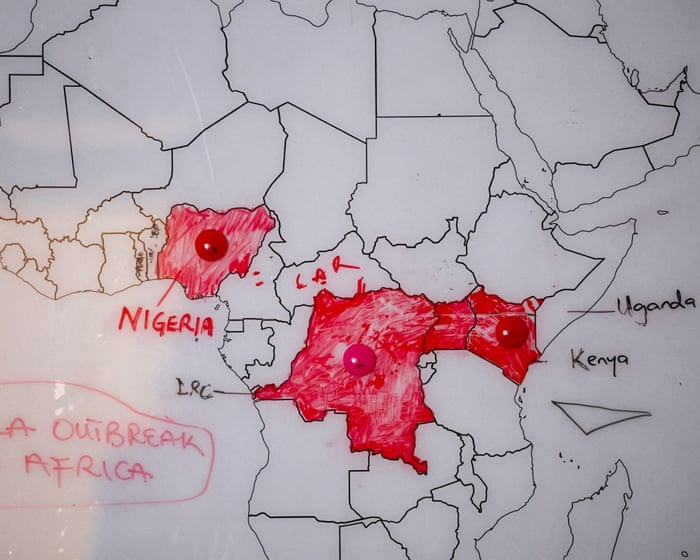
Africa’s ‘unprecedented’ Ebola outbreak could reach UK, says top health official
Jean Kaseya, of the Africa CDC, warns of the illness spreading like Covid unless more funding is secured to increase preparedness and possible treatment The “unprecedented” spread of the Ebola outbreak means it could reach the UK and other countries, according to one of Africa’s
World news | The Guardian ·

JWST reveals a distant galaxy that may let most of its ionizing radiation escape
Astronomers using the James Webb Space Telescope (JWST) have found evidence that a distant, exceptionally blue galaxy may allow most of its ionizing radiation to escape into space. Known as EBG-1, the gravitationally lensed galaxy is seen at a redshift of 9.244, about 530 million
Phys.org - latest science and technology news stories ·