التقنية والذكاء الاصطناعي
Research roundup: 6 cool science stories we almost missed
المصدر: Ars Technica - All content · نُشر
It’s a regrettable reality that there is never enough time to cover all the interesting scientific stories we come across. So every month, we highlight a handful of the best stories that nearly slipped through the cracks. September’s list includes a tantalizing hint of the elusiv
It’s a regrettable reality that there is never enough time to cover all the interesting scientific stories we come across. So every month, we highlight a handful of the best stories that nearly slipped through the cracks. September’s list includes a tantalizing hint of the elusive dark matter at the LUX-ZEPLIN detector; entangled Z bosons at the Large Hadron Collider; possible use of psychoactive substances in the Late Pleistocene; and an intriguing technical description of a telescope attributed to Galileo.
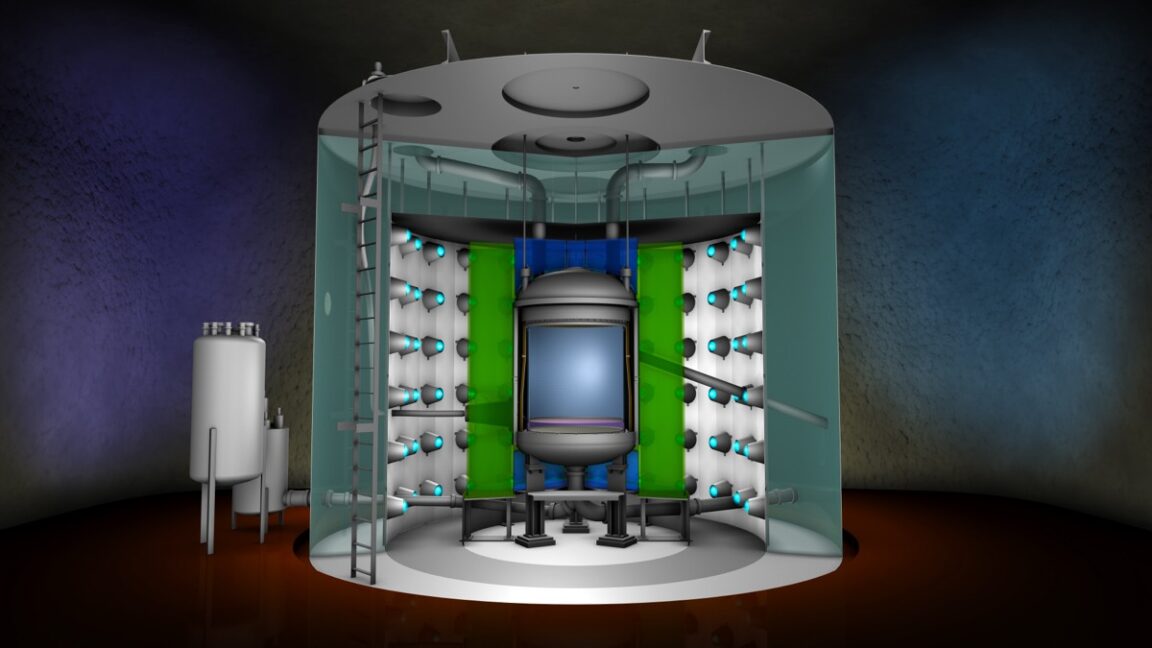
A hint of dark matter? Physicists believe dark matter makes up roughly 85 percent of matter in our universe, with the strongest (but not only) candidate being so-called weakly interacting massive particles (WIMPs). But directly detecting WIMPs, or other alternative hypothetical dark matter particles, has eluded physicists for decades.
We might have our first glimpse, however, courtesy of the LUX-ZEPLIN detector buried deep in a gold mine in South Dakota. Those potentially exciting results were presented in a scientific talk at the 2026 TeV Particle Astrophysics conference in Japan, with a preprint available on the arXiv. (It has been submitted to Physical Review Letters for peer review.) The announcement came with strong caveats: the signal is just a hint, well below the threshold needed to confirm discovery, and might just be a statistical fluke.
Anyone who regularly follows dark matter news knows that past tantalizing anomalies evaporated as more data came in. But the LUX-ZEPLIN team was unable to account for this event and decided to report their result to the broader physics community. They are still collecting data, as is the XENONnT at the Gran Sasso National Laboratory in Italy.
And China's PandaX detector is currently being built. Read full article Comments
أخبار ذات صلة

These AI Experts Want to Do High-Stakes Research Out in the Open
Many frontier labs keep their risky research locked away. Trillium Labs wants to show off its work when it comes to self-improvement and model behavior.
WIRED ·

Smart silicone coatings can change their friction and stickiness as surroundings reshape nanoscale layers
Research led by a group from the University of Newcastle has found a new way to make silicone surfaces—and control how slippery they are. The work was published in the journal Chemistry of Materials.
Phys.org - latest science and technology news stories ·

New research shows how water would behave on the moon
As humanity looks toward future bases on the moon, plant cultivation will be critical for sustaining life there. Plants can provide food, oxygen, medicine, water purification and waste recycling, making them indispensable for lunar development.
Phys.org - latest science and technology news stories ·
Quantum computer simulates matter “popping into existence”
Scientists recreated a particle-forming process linked to the extreme physics of the early universe using a 13-ion quantum simulator. The breakthrough suggests quantum computers could eventually help researchers investigate how matter formed and evolved after the Big Bang.
All Top News -- ScienceDaily ·
Why cheap power could matter more than clean power in the push for net zero
The question of how important making our electricity clean is to going green is coming under increasing scrutiny
feeds.bbci.co.uk ·