التقنية والذكاء الاصطناعي
James Webb telescope finds ice older than the star it orbits
المصدر: Ars Technica · نُشر
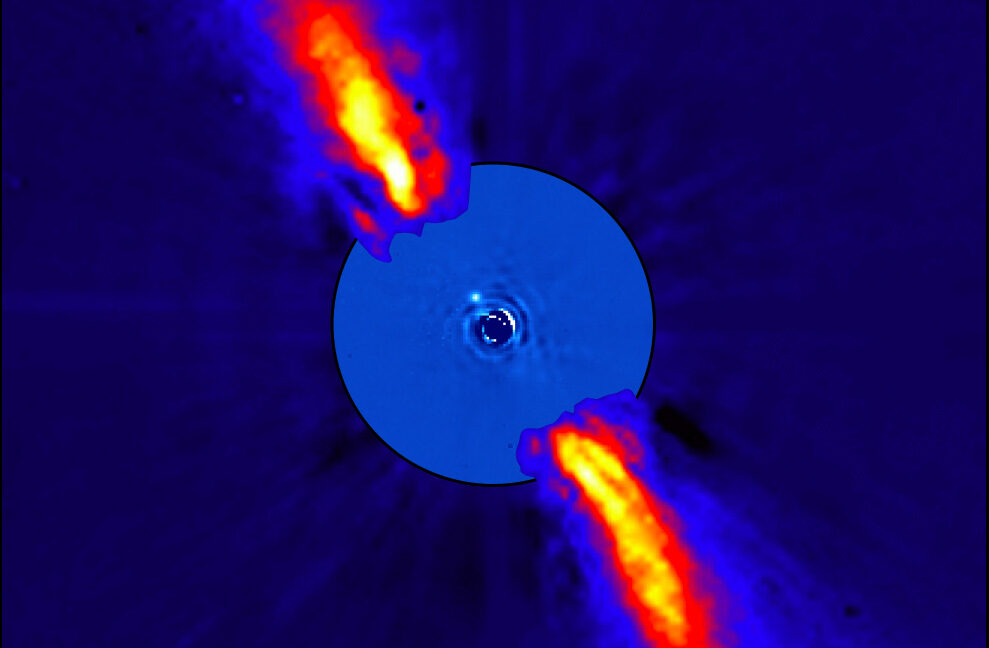
Beta Pictoris is a young star, roughly 20 million years old, and located about 64 light-years away from Earth. It is surrounded by a vast disk of dust and rubble where planets are still forming—astronomers have already found three. In a new Science study, a team led by Sarah Bett
Beta Pictoris is a young star, roughly 20 million years old, and located about 64 light-years away from Earth. It is surrounded by a vast disk of dust and rubble where planets are still forming—astronomers have already found three. In a new Science study, a team led by Sarah Betti, an astronomer at the Space Telescope Science Institute in Baltimore, used the James Webb Space Telescope to look for ice in this disk.
Researchers found both water and carbon dioxide ice. The water ice is glassy rather than crystalline, and it is mixed with carbon dioxide in roughly the same proportions we see in comets of our own Solar System. This suggests ingredients necessary to form water-rich worlds might be common around young stars.
The missing ice Beta Pictoris is one of the best studied stars in the sky. Its disk was among the first ever imaged, back in 1984, and we see it almost exactly edge-on, which makes it a natural laboratory for studying how planetary systems grow. It's what astronomers call a debris disk, where the dust is constantly replenished by collisions among comets and planetesimals, small bodies that are the building blocks of planets.
Read full article Comments
أخبار ذات صلة

Cryosphere decline beyond safe planetary limits, putting conditions for human society at risk
New research published at COP31 issues a stark warning about the health of the frozen parts of the planet—ice sheets, mountain glaciers, sea ice, permafrost and snow cover—known as the cryosphere. The study, published in Science, finds that human-driven climate change is degradin
Phys.org - latest science and technology news stories ·
The Sun unleashed a monster storm. Earth may have made it worse
The massive solar storm that illuminated skies worldwide in May 2024 has uncovered an unexpected twist: Earth's own atmosphere may have helped make the storm so powerful. Satellite measurements revealed that roughly 85% of the charged particles fueling the disturbance originated
All Top News -- ScienceDaily ·
Astronomers discover hidden alien planet in James Webb images
A breakthrough in telescope imaging could reveal countless alien worlds that have been hiding in plain sight. Scientists developed a new technique that uses a digital twin of the James Webb Space Telescope to remove the overwhelming glare of stars, making faint exoplanets two to
All Top News -- ScienceDaily ·
Meteors don't just burn up. What really happens is far more violent
Scientists have uncovered seven surprising stages that space rocks go through as they hurtle toward Earth, revealing that melting and violent fragmentation, rather than simple evaporation, determine their fate. The discovery could help explain why meteorites scatter across the gr
All Top News -- ScienceDaily ·
Scientists discover a hidden oxygen reservoir deep inside Earth
Scientists have discovered that magma deep inside Earth can store surprising amounts of extra oxygen, potentially revealing a hidden contributor to our planet's oxygen-rich atmosphere. The findings suggest that ancient volcanic eruptions may have helped transform Earth's atmosphe
All Top News -- ScienceDaily ·