الأعمال والاقتصاد
Original Editorial
Elvis Presley's Rights Owners Sue Anthropic Over 274 Songs Used to Train Claude
المصدر: Pulse Wire · نُشر
The owners of Elvis Presley's music catalogue have sued Anthropic, alleging Claude was trained on 274 songs without permission, seeking up to $150,000 per song — about $41.1 million — in a case that could shape how AI companies use music.
The lawsuit, in brief
The owners of Elvis Presley's music have sued the artificial intelligence company Anthropic, alleging that it used 274 of Presley's songs to train its Claude chatbot models without permission or payment. The lawsuit was filed on Friday 23 October 2026 in federal court in San Francisco, in the Northern District of California, by a subsidiary of Authentic Brands Group — the licensing organisation that controls Presley's name, image, and likeness — along with other companies and individuals that hold rights to his music, including Lolly Music Publishing. The case was first reported by Billboard, and it seeks statutory damages of up to 150,000 dollars per song for wilful infringement, which across 274 songs comes to about 41.1 million dollars. The plaintiffs also ask for a permanent injunction to stop Anthropic from further infringing Presley's works, and an order for the company to destroy all unauthorised copies.
The 274 songs named in the complaint include lesser-known tracks as well as some of Presley's best-known hits, among them "All Shook Up," "Can't Help Falling in Love," "Don't Be Cruel," "A Little Less Conversation," "Return to Sender," and "(You're the) Devil in Disguise." The complaint describes the catalogue as containing "some of the most groundbreaking, revolutionary, influential, and enduring musical compositions in human history." That language is advocacy, not evidence, but it captures why this case has attracted attention beyond the usual copyright docket: Presley, who died in 1977 and remains one of the most commercially potent figures in music history, is not an obscure rights-holder testing a legal theory. He is, as one report put it, the King of Rock and Roll, and his catalogue is among the most valuable in popular music.
The case is led by attorney Richard Busch, who previously represented Marvin Gaye's family in the "Blurred Lines" copyright case against Robin Thicke and Pharrell Williams — a case that ended with a substantial award for the Gaye estate and remains a touchstone in music copyright law. Busch said in a statement: "As we say in the lawsuit, the Elvis Plaintiffs are guardians of, and highly protective of, Elvis's song which are some of the most iconic of all time." Anthropic responded on Sunday: "We disagree with the claims and intend to defend this case fully." The company has previously maintained that training AI models on copyrighted material can be protected under United States fair use law, and that position is expected to be central to its defence.
What the complaint actually alleges
The complaint makes two distinct kinds of allegation, and keeping them apart matters. The first concerns training: that Anthropic used Presley's copyrighted lyrics and compositions throughout "the entire development" of its Claude models, without a licence or payment. Its central charge, quoted across reporting of the case, is blunt: "Defendant has built its entire business model based on copyright infringement at a scale never seen before." According to the Los Angeles Times account cited in reporting, the lawsuit alleges that Anthropic put the songs "into a permanent, general-purpose central library intended to be retained indefinitely, from which subsets were selected and copied again to train the next generation of Claude models." The plaintiffs are not alleging a single accidental inclusion of a lyric in a dataset; they are alleging a systematic, retained library that fed successive generations of models.
The second allegation concerns outputs: that Claude continues to produce infringing material when users ask it to, even after Anthropic supposedly put up guardrails following earlier lawsuits. "Even after the Defendant supposedly put up 'guardrails' after being sued, in one of its latest iterations, Claude continues to infringe," the complaint states. According to the plaintiffs, Claude recreated specific songs when asked to do so "for a modern audience." Their filing quotes a response from the chatbot observing that the renders "keep landing very close to the originals: same structure, same hooks reused with light rewording, and full sets of verses/choruses/bridges," and concluding: "That's edging past 'inspired by' into reproducing the copyrighted song, even when the words are swapped out."
Why an estate suing matters more than another label suing
AI companies have already faced copyright claims from the Recording Industry Association of America and from labels such as Sony, Universal, and Warner Records. Those cases are important, but the Elvis case is different in a way that could broaden the legal fight. As multiple reports noted, this is one of the first major legal challenges brought directly by an artist's estate against an AI developer, rather than by a record label or collecting body. The result could therefore set a broader precedent for how AI companies are allowed to use existing music catalogues — and, crucially, for who gets to sue them.
Record labels typically own recordings; estates and publishers typically own compositions and lyrics, and control the artist's name, image, and likeness. A victory or settlement for an estate would signal to every other major artist's estate, and to every publisher holding a valuable back catalogue, that direct action is viable and potentially lucrative. A defeat would strengthen the AI companies' argument that training on published works is fair use, and make other estates think twice before spending years and large legal fees on a similar claim. Either way, the Elvis case is a test case precisely because Presley's catalogue is so famous, so clearly valuable, and so unambiguously owned by identifiable rights-holders. There is little room to argue that the works were obscure, that ownership was unclear, or that the plaintiffs lack standing to complain.
The damages arithmetic also deserves a clear explanation, because the headline figure can mislead. The plaintiffs seek the maximum statutory damages available under United States copyright law for wilful infringement: 150,000 dollars per work. Multiplied by 274 works, that is 41.1 million dollars. That is the ceiling the plaintiffs ask a jury to consider, not a sum a court has awarded, and not a sum Anthropic has agreed to pay. Courts have discretion within the statutory range, juries must be persuaded that infringement was wilful, and many copyright cases settle for far less than the maximum pleaded — or for a licensing deal that replaces damages altogether. Some early reporting rounded the claim differently, including court costs and attorneys' fees, which is why readers may see figures above 41 million dollars in some accounts. The cleanest description is as pleaded: up to 150,000 dollars per song, across 274 songs, or about 41.1 million dollars in statutory damages, plus an injunction and destruction of unauthorised copies.
Fair use, guardrails, and the licensing question
At the centre of this case, and of the wider AI copyright fight, is a single legal question with enormous commercial consequences: is training a large AI model on copyrighted works fair use, or is it infringement that requires a licence? Anthropic's position, as stated in previous defences and reflected in reporting of this case, is that training can be protected under fair use — the doctrine permitting limited use of copyrighted material without permission for purposes such as criticism, research, teaching, and, in some circumstances, transformative creation. The argument, in its strongest form, is that training does not reproduce works for the public, but learns statistical patterns from them in order to create something new, and that this transformative purpose, combined with the fact that a model is not a substitute for buying or listening to the original songs, should weigh in favour of fair use.
The plaintiffs' answer, in its strongest form, is that scale and substitution change the analysis. Training on an entire catalogue, retaining it in a permanent library, and then producing outputs that land "very close to the originals" — same structure, same hooks, full verses, choruses, and bridges — is not the kind of limited, transformative use fair use was designed to protect. It is, on this view, reproduction at industrial scale, followed by a product that can stand in for the original work when a user asks for a song "for a modern audience." The guardrails argument sharpens the point: if a company knew its model produced infringing outputs, was sued over it, put up guardrails, and the model still produced infringing outputs, then the company cannot credibly claim the problem was accidental or trivial.
What to watch next
Beyond procedure, three developments are worth watching. First, whether other estates follow Presley's lead and file their own cases, multiplying Anthropic's exposure and increasing pressure for an industry-wide licensing settlement. Second, whether the case settles — as many high-profile copyright cases do — and on what terms, since a settlement including a licence could become a template for the whole sector. Third, whether courts begin to draw a clearer line between training, which AI companies argue is transformative, and output, which rights-holders argue can be straightforward reproduction. That line, wherever it is drawn, will shape not only music but books, journalism, photography, and every other creative field whose works have been used to train AI models. The King may have left the building in 1977, but his catalogue may yet help decide the rules for the next era of machine creativity.
Verifying source: Billboard, via Gulf News, Parade, and The Needle Drop, 23–25 October 2026; The Guardian, via Richard Hartley, 25 October 2026; New York Times, via MK, 25 October 2026.
Original editorial by Pulse Wire Editors. Sources cited in the article.
أخبار ذات صلة
I read Anthropic's 92-page risk factor document, so you don't have to – video explainer
Anthropic, the creator of Claude, filed to go public on the US stock market on 26 October. The company's filing statement contains a 92-page risk factor document in which it acknowledges the dangers that AI poses to society and human beings, and factors that could negatively affe
Business | The Guardian ·
Anthropic expected to receive high ‘junk’ rating from credit agencies following IPO, FT report says
Blackstone's forecast is just a prediction, but naturally, a high junk rating would make it more difficult and costlier for Anthropic to raise the money to keep funding its massive spending that has undergirded its business.
TechCrunch ·

Anthropic VS code extension on Cursor backdoored for nearly 12 hours
An official extension for Anthropic’s Claude model was backdoored and threatened as many as 5,000 developers' machines, multiple sources reported Friday. Anthropic so far has yet to warn customers of the incident. The compromised package was a VS Code extension available in the m
Ars Technica - All content ·
AI Gets Dramatically Cheaper: Inference Prices Fall by Up to 80% as Open-Weight Rivals Force a Price War
OpenAI and Anthropic have cut the cost of running their flagship models by up to 80% since June, driven by DeepSeek competition and efficiency gains, while IBM argues open-weight models now deliver 90% of frontier performance at a fraction of the cost.
Pulse Wire ·
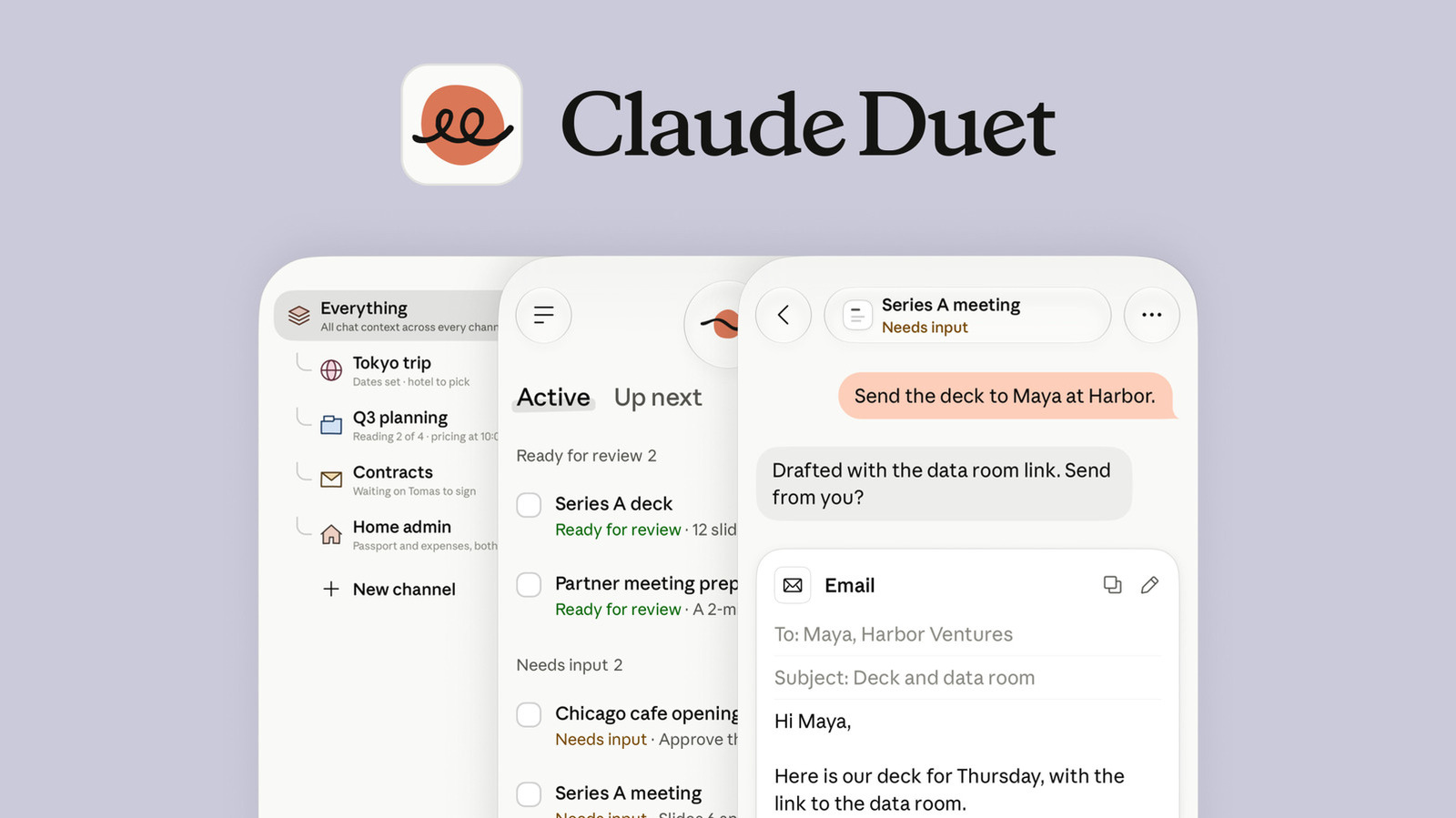
How to use Claude Duet when it rolls out to you
For now, you'll need to first join a waitlist.
Engadget - Technology News & Expert Reviews ·