الثقافة والترفيه
Does M John Harrison’s Booker win mean science fiction is finally accepted by a ‘snobby’ literary establishment?
المصدر: Culture | The Guardian · نُشر
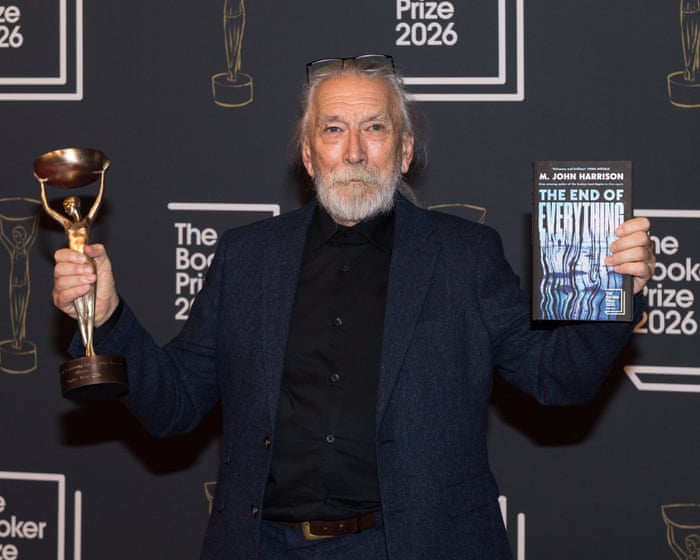
Kazuo Ishiguro, Jeff VanderMeer, Olivia Laing and other writers weigh in on the publishing world’s genre wars As M John Harrison was announced as the Booker prize winner on Monday evening, the 81-year-old looked gobsmacked. Decades into his career, and long overlooked by the main
Kazuo Ishiguro, Jeff VanderMeer, Olivia Laing and other writers weigh in on the publishing world’s genre wars As M John Harrison was announced as the Booker prize winner on Monday evening, the 81-year-old looked gobsmacked. Decades into his career, and long overlooked by the mainstream literary establishment, he had just won a prize that has never before rewarded a writer known for science fiction, with a decidedly fantastical book. His fans, many leading authors among them, are thrilled.
“For decades it was a standard – and correct – nerd whine to point out that sentence for sentence, book for book, Harrison was one of the greatest writers out there, full stop, but that ‘mainstream’ prizes never reflected that,” says China Miéville, who last week won the Goldsmiths prize with his 1,200-page speculative novel The Rouse . Back in 2002, Miéville wrote that Harrison not having won a Booker by that point proved “the bankruptcy and back-slapping generic snobbery of the literary establishment”. Now, he says: “I am so delighted, for Harrison, and for fiction.” Continue reading...
أخبار ذات صلة

‘We are dream-walking into a desperate situation’: the Booker prize winner on his sci-fi alien invasion wakeup call
He is a sci-fi titan but M John Harrison has just exploded into the mainstream – with The End of Everything, an apocalyptic novel set on the Kent coast. Does he really think we have no hope left? With his twinkling eyes and silver ponytail, M John Harrison doesn’t seem anything l
Culture | The Guardian ·

Glass does surprising things when stretched 1 atom wide. The discovery could help shrink electronics
Smartwatches worn on millions of wrists today pack vastly more processing power than the computers that helped Apollo astronauts land on the moon. But the scientific drive to go tiny has come at a cost: It means heat, electricity and energy now have much less room to flow through
Phys.org - latest science and technology news stories ·

Does Pickford finally face serious competition for his England place?
Does England's long-time first-choice goalkeeper Jordan Pickford finally face serious competition for his place, asks chief football writer Phil McNulty.
feeds.bbci.co.uk ·

Why does Australia want Brits to swap Sydney for the outback?
Australia wants changes to UK deal that would push backpackers out of Bondi and into remote regions.
feeds.bbci.co.uk ·

What is the Paris Agreement and why does 1.5C matter?
The 2015 pact is at the heart of the international commitment to tackle rising global temperatures.
feeds.bbci.co.uk ·